• Français
Containerized Hyperbaric Chamber Rental Service

Containerized Hyperbaric Chamber Rental Service

Containerized Hyperbaric Chamber Rental Service

The benefits of renting containerized hyperbaric chambers: mobility, flexibility, safety, and performance for all your projects!

COMEX offers a containerized hyperbaric chamber rental service among its range of products and services. These equipments offer great versatility, as they can be transported by land, sea, and air. Thanks to our flexible rental solutions, you can benefit from hyperbaric facilities without investing in permanent installations. In addition, we provide you with a medical hotline service available 7 days a week, 24 hours a day, guaranteeing you continuous assistance.

The flexibility of the containerized structure:

Due to their containerized design, our hyperbaric chambers offer great flexibility in use. They can be moved quickly and efficiently over long distances, whether on a truck for land-based projects, or using maritime means for sea projects, or by air for special missions. This mobility allows to meet all your needs, regardless of their location.


It is a standalone equipment, with its own air production as well as its therapeutic fluid gases. This autonomy ensures great independence and additional adaptability during the use of the hyperbaric chamber.


For a perfect handling by your teams, we provide training on the use of the equipment. If necessary, we can also dispatch a qualified operator to assist you. Thus, you will benefit from complete and personalized support for optimal use of our hyperbaric chambers, safely and efficiently.
Whether you need a turnkey solution or prefer to manage the operation yourself, our rental service will be able to offer you a formula adapted to your requirements.

Equipment description

Each chamber, with a diameter of 1600 mm or 1500 mm, is equipped with 700 mm diameter chamber access doors supporting a working pressure of 4 bars. These therapeutic hyperbaric chambers allow for the simultaneous treatment of several patients, offering a capacity to accommodate 4 seated patients or 2 lying patients per unit..

They are delivered with their air production and the distribution of therapeutic fluids, according to the needs. The plurality of these equipments guarantees great flexibility and reliability, thus ensuring optimal patient care.

The chamber is composed of:

  • 1 spacious main chamber equipped with breathing stations
  • 1 transfer airlock equipped with a breathing station
  • 1 medication airlock
  • 2 hyperbaric fire extinguishers
  • 1 control console equipped with communication system, pressure gauges, and gas analyzers

The container features:

  • 1 hard plan for stretcher transport of an injured person
  • Therapeutic fluids distribution
  • Air production including the HP/LP compressor, compressed air storage, and distribution network

Therapeutic gas bottles are provided according to needs

The plurality of the equipment guarantees our clients autonomy and great flexibility, ensuring optimal use.

Varied applications of rented containerized hyperbaric chambers in various environments

Contribution to the Grand Paris tunnel construction site

Our containerized hyperbaric chambers were used in the context of the Grand Paris project, a construction site involving many tunnel boring machines.
In this context, the projectable chambers made it possible to bring an essential safety element to the hyperbaric operations as close as possible to the tunnel excavation sites.

Use in marine environments

These chambers can also be adapted for specific missions in marine environments. They serve as emergency recompression chambers. Simple, safe, and efficient to use, the container and its chamber can be easily embarked and autonomous, guaranteeing divers safety right at their diving site.

Continuity of medical care

In periods of maintenance or temporary interruption of a hospital center’s operation, it is essential to guarantee the continuity of medical care. In this context, our containerized chambers serve as a reliable and efficient solution.
They can be delivered according to needs, either with their air production and the distribution of therapeutic fluids, or connected to the facility’s network. They are equipped to accommodate up to four seated patients or two lying patients and have a range of accessories for various therapeutic needs, thus ensuring appropriate care for various situations.

A 24/7 medical hotline service

COMEX offers its clients, in addition to the rental of its chambers, a hyperbaric medical advisory service available 24/7. Conducted by doctors specialized in hyperbaric medicine, this remote service helps your teams to quickly undertake the right courses of action.
These doctors are perfectly familiar with, and have validated, our chambers. They conduct training on emergency handling in chambers before your missions. Finally, their hotline can be contacted at any time, allowing you to make the right decisions.

Decennial Maintenance of Hyperbaric Facilities (R120)

Decennial Maintenance of Hyperbaric Facilities (R120)

COMEX specializes in the design and implementation of maintenance plans for hyperbaric facilities in compliance with the European Pressure Equipment Directive (DESP). Customized based on the specific needs and conditions of each client, our goal is to provide management and maintenance services tailored to each context. Our aim is to ensure the best value for money, reliability, constant availability, and the safety of our devices while also preserving environmental protection.

The European Pressure Equipment Directive (DESP) sets the requirements for pressure equipment to ensure their circulation within the European Economic Area.

Operational Maintenance of Hyperbaric Chambers (MCO)

Since 2009, COMEX has been responsible for the operational maintenance of hyperbaric chambers for the French Navy. This includes approximately 32 chambers distributed across naval bases in France. After the requalification of the CHM500 at the Toulon naval base, which took place from September 2020 to July 2021, it was the turn of all the “CML*” type chambers installed on various Navy vessels, also known as “units.” There are 25 of these chambers. These requalifications, governed by the latest applicable decree (Decree of November 20, 2017), allow our teams to work on all chambers equipping the vessels to perform a complete installation check-up, all with the aim of ensuring another 10 years of operation..

*CML: Lightweight Multiplace Chamber

Procedure of an R120

    • Establishing an assessment of the chamber upon arrival at the COMEX workshop, documented in the reception report
    • Conducting rapid functionality tests to verify the initial supply of the chamber
    • Performing a complete disassembly of the chamber
    • Conducting an inspection of the chamber by SGS
    • Performing a hydraulic test at 1.5 times the working pressure using a booster, always under the supervision of SGS (a new valve is installed)
    • Drying the chamber
    • Reassembling all elements of the chamber
    • Conducting pressure tests on the chamber. Pressure tests are typically finalized with a dive conducted by a French Navy diver and a COMEX operator*
    • Drafting the maintenance report

Particularity of an R120 requalification

In the case of R120 conducted at the COMEX workshop, our diving teams are made available to perform the dive at 10m.

The particularity of an R120 requalification is that it includes a hydraulic test at 1.5 times the working pressure (Ps). In this case, with a working pressure of 5.2 bars, the test is conducted at a pressure of 7.8 bars.

An R120 immobilizes the chamber for approximately 3 weeks and also provides an opportunity to make modifications and improvements that have been identified during their use over the previous ten years.

For each improvement proposal, COMEX prepares a study file that needs to be validated by the French Navy, after which the service is commissioned by them.

Through many types of services, COMEX has been supporting the Defense sector and international armed forces for over 50 years.

We are committed to providing high-quality services in compliance with the strictest standards of safety and reliability, all with great responsiveness. Our partnership with the French Navy is based on mutual trust and close collaboration, which has lasted for nearly 15 years.

New generation of recompression chambers for the French Navy

New generation of recompression chambers for the French Navy

New generation of recompression chambers for the French Navy

Photo l’Ophrys : ©Jean-Claude BELLONNE

As part of a contract with the Merré shipyard, COMEX was tasked with studying, manufacturing, integrating, and validating hyperbaric chambers for the Diving Support Vessels (VSP) delivered to the French Navy. This collaboration involves eight CX1800 recompression chambers and is part of a larger program led by the Directorate General of Armaments (DGA), which aims to modernize France’s underwater mine clearance capabilities. It also highlights COMEX’s ability to meet the requirements of both the armed forces and the professional diving sector.

hese vessels will be used by the Saint-Mandrier Diving School as well as by the mine clearance diving teams stationed in Toulon, Brest, and Cherbourg. COMEX ensured the complete integration of the hyperbaric chamber and the associated gas networks, from its workshops to the final operational site.

Recompression chambers designed for military standards.:


The recompression chambers offered by COMEX are designed to provide rapid and secure care for divers in the event of a decompression accident. They enable the administration of hyperbaric treatments in accordance with current protocols and in compliance with international standards.

Their compact structure and ergonomic design facilitate integration aboard ships or within terrestrial infrastructures. They are also adapted for intensive use in operational environments.

An interior design optimized for medical efficiency


The CX 1800 hyperbaric chamber stands out with an interior layout specifically designed to meet the most stringent requirements of emergency interventions. At the core of this system, the modular stretcher exemplifies the ingenuity of the design: it allows for optimal patient positioning using robust and precise guide rails.

Three main positions – central, lateral, and intubation – are easily accessible and secured by a locking system. This flexibility provides healthcare professionals with full access to the patient while ensuring stability during treatment.

This system also facilitates a smooth transition of the stretcher between the inside and outside of the chamber, enabling efficient transfers in critical situations.


Thoughtfully designed down to the smallest details, the interior layout also integrates optimal placement of monitoring and ventilation equipment, freeing up space around the patient and making it easier for medical staff to work.

The new French Navy launches incorporating a COMEX recompression chamber are part of the Navy’s hyperbaric installations for which COMEX is responsible as part of the maintenance of operational condition (MCO) contract.

The new generation of COMEX hyperbaric chambers consists of a chamber and a lock and includes:

A control station located at the entrance of the hyperbaric chamber, consolidating the necessary equipment for its operation and use, following three modes of operation:

Automatic: Allows the automatic execution of treatment tables from a user-configured library.
Semi-automatic Features linear electric controls, providing flexibility and precision.
Manual: Equipped with high-precision regulation valves.

  • A high-definition video surveillance system for the chamber with transmission to the control panel,

  • A new communication system developed by COMEX, meeting the specific requirements of hyperbaric chambers,

  • A backup power supply system ensuring more than 6 hours of autonomy for chamber use,

  • A complete hyperbaric fire suppression system with spray nozzles, compliant with hospital requirements,

  • A set of equipment for monitoring ambient parameters, along with an emergency system for absorbing exhaled CO2,

  • In the chamber: Three seats on folding chairs and one place for a patient lying on a multi-position stretcher,

  • Fluid distribution stations with on-demand regulators and exhaust for exhaled gases,

  • A hyperbaric ventilator,

  • A monitoring/defibrillator set equipped for telemedicine with real-time transmission of medical data.

Modularity and container integration


Designed for simplified logistics, the recompression chambers can be integrated into containers specially designed for transport and rapid deployment. This modular configuration allows for flexible installation in remote areas or on temporary operational sites, providing essential responsiveness in emergency situations.

caisson hyperbare projetable en conteneur

A range suited to all needs


In addition to the large-capacity CX1800 models, COMEX also offers smaller-sized recompression chambers, designed for structures requiring a more compact solution. These models maintain the same safety and performance standards while providing increased flexibility for various applications.


Professional and military applications


Recompression chambers are key elements in the treatment of decompression accidents and the implementation of post-dive safety protocols. In the military context, they play a crucial role in ensuring the safety of divers and mine clearance teams.

For civilian professionals in the diving industry (such as underwater construction, inspection, and offshore maintenance), these chambers provide a tailored solution to meet the safety and performance requirements expected on the most complex job sites.

Conclusion

With a range of modular and high-performance recompression chambers, COMEX reinforces its role as a leader in the design of custom hyperbaric solutions. Built to last and designed for action, these devices align with a modern and demanding operational vision, meeting the specific needs of both military and professional sectors.

Regulatory and medical references

To further explore the regulatory and medical aspects related to the use of recompression chambers, you can consult the following resources:

Arrêté du 29 mai 2024 relatif aux interventions hyperbares sans immersion
La prévention des risques lors des activités en milieu hyperbare – Ministère du Travail

For more information on our hyperbaric solutions, visit our product page for the Deployable Hyperbaric Chamber.

Source: DGA Press Release, 14/11/22
Photos of the hyperbaric chamber: ©COMEX

Altitude simulator

Altitude simulator

As expert in hyperbaric simulation and operations, COMEX created its altitude simulator in 2016. This test facility recreates pressure conditions at altitude. This altitude chamber is now a reference tool for the aeronautics and space industry, to meet their needs for validation and certification of new equipment.

Meeting the needs of the aerospace industry

The altitude simulator, developed and transformed over the past 10 years by COMEX within its hypobaric test center, meets the growing need for testing methods to simulate altitude conditions for human subjects. This 20m² hypoxic chamber cabin can accommodate several people (subjects, medical staff, technical staff) at the same time and simulate flights up to 40,000 feet (~12,000m) in altitude. These aeronautical altitude tests are always conducted under medical supervision.

Medical support

To this end, COMEX has joined forces with Phymarex: a group of doctors, nurses and researchers who are experts in underwater, aeronautical and space medicine. These specialists have been using hyperbaric and hypobaric chambers to treat various pathologies since the 1970s. During the 2000’s, they started a collaboration with occupational physicians in the aeronautical sector, in order to assist them in the realization of studies on the flight personnel. Gradually these studies were carried out in the COMEX  altitude simulator. Further, in 2016, the Regional Health Agency (ARS) granted COMEX approval to carry out tests, under medical supervision on healthy subjects. This approval has led to a wide variety of tests being carried out. Research and development on medical equipment, onboard equipment such as oxygen masks and smoke protection hoods. But also physiological experiments for adaptation to very high altitude environments

Hypoxic training

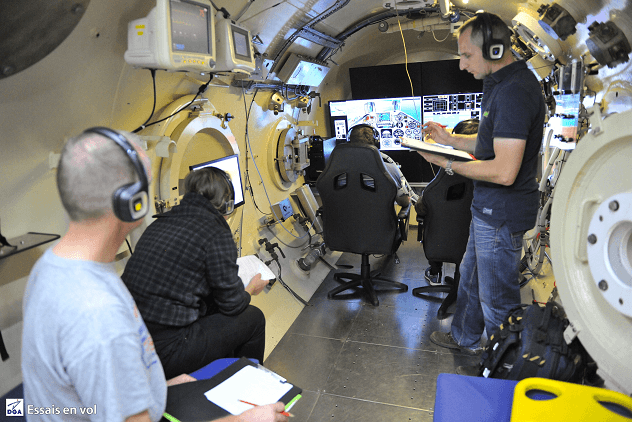
Or finally, as explained by Dr Mathieu Coulange (Head of the hyperbaric center of the APHM) for the sensibilization to the hypoxic risks for flight personnel.

« Or finally, as explained by Dr Mathieu Coulange (Head of the hyperbaric center of the APHM) for the sensibilization to the hypoxic risks for flight personnel. “We install them on a flight simulator and we reproduce the cabin environment. After having them breathe air at the beginning of the session, without warning them, we will switch them to a 12% under-oxygenated mixture, they will feel symptoms due to hypoxia, which they will have to announce, to be able to prepare them to detect the lack of oxygen which could happen when there is a cabin depressurization or when the oxygen masks malfunction.»

To date, more than 150 people have participated in these simulated flights, without a single medical accident.

Throughout its history, COMEX has demonstrated its ability to push back the limits of professional diving thanks to two axes: innovations in equipment and a better understanding of the physiological effects of high pressure.
It is now continuing this work by focusing on altitude and very high altitude.

Maintenance in operational condition of hyperbaric installations

Maintenance in operational condition of hyperbaric installations

The Maintenance in Operational Condition (MCO) are the measures taken to guarantee breakdowns’ diagnosis and defective parts’ replacement, ensure conformity, modernization and treatment of the obsolescences, as well as crew training and documentation supply, within the framework of a continuous production.

Aim of a maintenance in operational condition

In industrial, medical, systems and controlled pressure solutions (hyperbaric, hypobaric) environments, Operational Condition Maintenance consists of ensuring the functioning and performance of equipment during the entire operating phase. This includes all the resources required to keep equipment in a state of readiness to meet the demands made on it, while ensuring maintenance, replacement of parts, compliance and compliance with the regulatory inspections required by ministerial decrees. Products and systems have a limited lifespan. Their use subjects them to breakdowns, replacement of parts, aging obsolescence, wear and tear and new constraints: technological advances, regulatory standards, preventive renewal of consumables.

Comex has just successfully completed the regulatory requalification as well as a series of modernization of the 500-meter diving simulator “CHM500” composed of 4 hyperbaric systems located in Toulon naval base.

To talk about it, we have chosen to interview our project manager.

Emmanuelle Dubois, project manager at COMEX SA gives us an insight of this demanding project :

Hello Emmanuelle, can you introduce yourself?

Emmanuelle Dubois, project manager at Comex SA in charge of the MCO of hyperbaric chambers for the French Navy.

An important step for this contract renewal has just been completed, can you tell us more?

Yes indeed, with the end of the CHM500’s requalification, we’ve completed an important step in the 5-years contract with the French Navy. This is the R120, the mandatory 120 months (10 years) regulatory requalification every 120 months (10 years). During this requalification, the 3 dry and the 1 wet enclosures are dismantled in order to check, test and clean each component. Each component which is dismantled, cleaned and tested. This requalification is validated by the realization of a hydraulic test for each enclosure at a pressure equal to 1.5 times the service pressure (i.e. 75bars). Following these tests, the center is requalified by a certifying body, then by the French Navy itself, and this, for 10 years.

The opportunity to expose the center also allows us to carry out improvement requests formulated upstream by the customer, to which we have offered solutions that have been accepted.

With regard to these improvements that have been made, can you tell us a little more about them?

Without going into details, we can however talk about :

    • Creation of a mobile analysis bay located next to the supervision desk, allowing a simultaneous report of the oxygen and CO2 concentration in each enclosure.
    • Modernization of an existing high pressure air distribution panel
    • Modernization of the communication networks in the dry chambers under pressure (50 Bars) and outside at atmospheric pressure
    • Addition of a hydrophone and laryngophone for divers in the wet chamber (called wet tank) and the Turret (chamber allowing the transition between the dry chambers known as “life” and the Wet tank)
    • Renovation of the interior paintings of the wet tank and the turret in adequation with the environment.
      Problems are diverse, 2 can be cited:
          • Issues related to the presence of a gaseous sky composed of Helium, which, with the speeds of compression and decompression, creates fine particles which, by bubbling effect take off the paint on the walls,
          • Problems related to the VOCs released by the paint in the hyperbaric and gaseous environment.

What is the “plus” provided by Comex in this type of service?

Despite the client’s hight level of specifications from the customer, Comex, with its 60 years long of experience in the hyperbarics field, is always able to come up with solutions. Thanks to the increased knowledge of the system, COMEX knows how to adapt and reinvent itself. This allows us to respond quickly and adapt to improvement issues in terms of safety as well as obsolescence treatment and staff comfort.

What happens next in this contract? This contract runs for another 3.5 years and concerns the maintenance in operational condition of 32 chambers (chambers on board ships, onshore chambers, experimental chambers and diving school‘s chambers for diving schools). In addition to the visits to be carried out within the regulatory framework, preventive maintenance, replacement of consumables, curative maintenance (treatment of damage) and continuous improvement (obsolescence and proposals for improvement) are and will continue to be carried out.

What do you personally remember?

Due to the health situation during which this requalification took place, the initial deadlines were extended and this stage only took almost a year! However, the result is positive. The requalification was completed and the new equipment was put into service. Even if the latter required some readjustments (apprehension of the new technologies), we were able to concretize these projects.

On a more personal note, having been at Comex for only 2 years with a period of confinement in the middle, I remember the team spirit at Comex, a solidarity and involvement that I have never felt elsewhere. Over and above the service that has to be provided, everyone is committed in to making sure that “it works” and to being there, present at every stage to support, repair, train or even alert us if necessary. I am certainly responsible for this project, but it is feasible and achievable thanks to the involvement of all the actors in the COMEX company.

Did you encounter any difficulties in integrating into your new professional environment?

For my part, I had no problems integrating. I was very well received, whether with my counterparts on the client side or in the field (ships, test center, etc.). The French Navy advocates, applies and conveys the so-called “basic” values, of which respect is one.

There are very few women in engineering, what do you think can be done to correct this?

The technical engineering professions remain little known or little valued for women. However, women do very well and are often well integrated into the workforce. The promotion of these professions through fairs and forums must continue to exist. I think that testimonies with a female presence to represent these professions, starting in the final year of high school, should be made to allow our future generations to visualize the extent of the possibilities and why not create new vocations and break the old clichés that are still a little too present. I would like to point out that more and more women are entering this type of profession.

Thank you Emmanuelle!

A long-lasting and fruitful partnership has united COMEX and the French Navy since 2009.

Our team is in charge of the maintenance in operational conditions of about thirty hyperbaric installations on its naval bases or on board its ships and vessels.

The new contract, notified by the fleet support service, started in March 2020 and will end in March 2025. COMEX is therefore involved in all the caissons fitted to the French Navy’s ships, particularly at the Brest, Cherbourg, Toulon, Saint Mandrier and Roscanvel naval bases. The whole team is happy to finish successfully the requalification of the CHM500 diving simulator!

Supply of a Cx1800 Projectable Decompression Chamber to the  Armada Argentina (Argentine Navy)

Supply of a Cx1800 Projectable Decompression Chamber to the Armada Argentina (Argentine Navy)

OPV – Offshore Patrol Vessel


COMEX has produced a containerized decompression chamber to the Armada Argentina. It is intended to equip an Offshore Patrol Vessel (OPV) that will be delivered by the French Company NAVAL GROUP


The selected hyperbaric chamber is a new generation model. Its design benefits from a unique experience, acquired both in the underwater industrial sector and in the Medical environment (Hospital and University).

For this new generation, the data crossing of the needs expressed both by the end-users and by the operators has allowed us to meet their expectations, to anticipate their demand and to propose a product perfectly adapted to their very needs.

This projectable containerized unit is a complete set ready for use. It bears the CE marking for pressure equipment (European Directive) 2014/68/EU.


KERSHIP 

KERSHIP is a joint venture company created in 2013 by PIRIOU and NAVAL GROUP, two experts in engineering and shipbuilding as well as in military systems and services.
This alliance is based on the complementarity of their experience and know-how:
PIRIOU, 50 years of experience in civilian shipbuilding.
NAVAL GROUP (formerly DCNS), a world leader in naval defence.
KERSHIP offers ships up to 95 meters long to fulfil all the needs of a State at sea : Navy, Coastguards, Customs, Safety at sea, Scientific Agencies…
Thanks to the expertise of its holding companies, KERSHIP accompanies the administrations and Navy forces throughout the life of their ships, from manufacturing to delivery, but also from after-sales services to maintenance in operational conditions (MCO).


COMEX.SA 

A global pioneer in the development of technologies for human and robotic intervention in extreme environments.
COMEX, through its in-house Engineering Team, has been designing, manufacturing and marketing hyperbaric oxygen therapy facilities since 1974. More than 200 facilities have been installed for public or private customers in France and around the world. The Services department is responsible for the maintenance, the periodical control and the modernization of the facilities.

CX1800 hyperbaric chamber

Product of the Cx2 «new generation» range

which integrates the latest technologies in pilotage. The hyperbaric system includes:
    • A decompression chamber, a control system, a compressed air production, storage and distribution Unit, a therapeutic fluids distribution Unit, all enclosed inside a 20 foot equipped cell.
    • The decompression chamber consists in the main chamber which accommodates up to 2 sitting patients and 1 supine patient, and the air entrance lock for 1 seating attendant.
    • Stainless steel fittings and storage with a modern and long-lasting design with surfaces designed for quick and easy daily decontamination,
    • LED based ambient lighting systems,
    • Anti-slip decontaminable, surgery room type floor covering
    • Reliability of industrial quality equipment,
    • The performance and the possibility of evolution of the control system using an industrial architecture with a programmable industrial automat and a supervision system,
    • The ergonomics and ease of use of the HMI with automatic management of healing decompression profiles, recording and real-time display of all parameters, with management of all failsafe systems,
    • Support and assistance in physiology/hyperbaric medicine,
    • The pressure hull is equipped with sound attenuation compression, ventilation and decompression feedthroughs and valves,
    • Large windows in DN 200mm ensure a perfect vision of the interior of the compartments and contribute to the general brightness,
    • In the lower part of the chamber, a technical hatch serves as an interface for the circuits of all medical devices (scope, hyperbaric respirator, syringe pusher, etc.),
    • The chamber is mounted on a support frame evenly distributing the load,
    • The control equipment is centralised on a console panel mounted directly on the chamber wall,
    • This control panel also includes a programmable automat that ensures the display and the traceability of the control parameters. It also increase the safety of the installation by means of the control of all the instrumented data,
    • The «mini-automat» architecture with touch screen meets the requirements of durability and operational safety,
    • The control system includes an industrial programmable automat and a touch screen of at least 10’’ and a supervision system that manages functionalities.

Organization of the project

In its capacity as Project Manager, Comex ensures the relations with the Project Owner and the management of the project as well as the coordination of actions with its subcontractors. The project will be led by a team that will bring its expertise and experience in hyperbaric systems and facilities, both from a technical and a physiological point of view.

The men, their skills, their missions

The project will be led by the following multidisciplinary team:
A Project Manager:
Its role is to ensure the conduct of the project in compliance with administrative, financial and timely objectives. He participates directly in the technical documentation and in the choice of the design. He coordinates the different activities required to carry out the project according to the stage of progress by identifying possible hard points and their impact on the objectives of the project.
A Quality Assurance Manager (QAR):
He is in charge of monitoring the quality of the project. It adapts and/or establishes the quality assurance procedures specific to this project and ensures internal audits.
The Engineering team:
Based at Comex facilities, It is responsible for the studies and the preparation of the documents necessary for the implementation of the project. It works at preparing workshop logistics and ensures the supply and follow-through of the necessary materials for the project.

Training in the use of the hyperbaric chamber

A new 5-year contract signed with the French Navy

A new 5-year contract signed with the French Navy


COMEX SA is pleased to have won the new public contract from the French Ministry of the Armed Forces for the MCO* recompression chambers. (* Maintenance in operational condition of the recompression chambers of the French Navy and Army).


COMEX SA is pleased to have won the new public contract from the French Ministry of the Armed Forces for the Maintenance in operational condition of the recompression chambers of the French Navy and Army.

Our team is in charge of maintenance for :

  • 31 hyperbaric chambers embarked on ship / container / ashore
  • 1 diving simulator chamber 500 m
  • 1 recompression chamber for the Army

For the maintenance of the French Navy’s hyperbaric chambers, the long-standing and fruitful partnership that links us began in 2009. Our team was already in charge for maintaining in operational conditions the 30 hyperbaric installations on its naval bases ashore or on board its buildings and ships.

The new contract, notified by the fleet support department, started in March 2020 and ends in March 2025. It gives COMEX the opportunity to work on all the hypobaric chambers arming the French Navy’s ships, including at the Brest, Cherbourg, Toulon, Saint Mandrier and Roscanvel naval bases, in order to carry out the regulatory inspections governed by the latest decree in force (Order of November 20, 2017).

The whole team is very pleased for this confidence renewal and for the work carried out for more than 10 years.

Our maintenance actions must guarantee the operational availability of all the hyberbaric chambers, including the maintenance of the 500-meter diving simulator in Toulon, usually called “CHM500”. Our technicians also remain mobilized to take action in case of damage so that the slightest breakdown can be repaired in less than 5 days, regardless of the location of the chamber concerned.

In addition, one of our missions will be to carry out the 10-year regulatory requalification of the 500m diving simulator; a guarantee of confidence since COMEX was already responsible for it 10 years ago.
The CHM500 center also wishes to modernize its equipment and trusts COMEX to provide innovative solutions that are adapted to their needs as well as to the particular conditions in which they operate.

A great proof of confidence for the COMEX teams specialized in hyperbaric technologies!


COMEX partner of Merré Shipyards

COMEX partner of Merré Shipyards

Located north of Nantes, Merré Shipyards are recognized as a multi-specialist in shipbuilding.
With the construction of eight military ships, 26.50-metre cruisers for French Navy’s mine clearance divers, Merré shipyards have been awarded their largest order ever.

DGA (French MOD) have selected this specialist in custom-made coastal ships to build a series of dive support vessels, a contract worth tens of millions of euros.

COMEX will be partner in this project and will equip the eight DSVs with their latest generation hyperbaric chamber units.

The eight aluminium Dive Support Vessels (VSP) will be assigned to support Navy mine clearance divers or commandos operations at sea.

Construction of the first vessel is scheduled to begin during the second semester of 2020, with tests at sea starting one year later.
Following a three-month operational evaluation of this first Vessel by the Toulon based Navy Mine Clearance Diver Unit, Merré Shipyards will carry on with the manufacturing of the seven remaining units, all of which to be delivered by 2025.

The 8 diesel-electric hybrid vessels will be dispatched to support the groups of clearance divers at the Naval Bases of Toulon, Brest and Cherbourg, as well as the Navy diving school of Saint-Mandrier.

Comex Engineering Department is responsible for the design and the manufacturing of the hyperbaric chamber units at their factory as well as for the installation and the commissioning on board the VSPs.

Comex Services Department will provide end user personnel hands-on training for the operations and maintenance of the dive support equipment.

Hypoxia risk awareness

Hypoxia risk awareness

The Comex Hypobaric Test Center is pleased to regularly receive a delegation of students and instructors of EPNER (School of flight test and reception staff) for an hypoxia risk awareness session in altitude chamber hypoxia training.

©EPNER

EPNER

Formerly flight test center / CEV created in 1946, now part of DGA Flight Test Dpt, EPNER trains crews involved in test flights ; theoretical courses come along practical hands-on exercises that allow in-flight tests of the aircraft characteristics, carried out under the optimum safety conditions. Trainees are : test pilots, engineers, mechanical and test engineers as well as air traffic controllers for specific test flights.

Located in Istres (60 km from Marseilles) since 1962, EPNER carries out its activities within the DGA (General Delegation for Weapons, a branch of French MOD). This gives the school a unique position between the Armed forces and the Industry on one hand, and between military and civilian testing sectors on the other hand. EPNER has been training crews in these different areas for more than 70 years.

The high quality of this training, based on teamwork between pilots, engineers and air traffic controllers, is recognized at the highest levels of the international aviation community.

 Comex Altitude Simulator for human subject test aeronautical oxygen equipment 

 In order to carry out hypobaric tests in the field of aeronautics and space, Comex Test Center of has been equipped since 2017 with an hypoxic chamber, also called hypobaric chamber oraltitude simulator.

The possibility of reproducing in this 20m2 hypoxic room flight conditions up to 40 000 meters of altitude (131 000 feet), allows our partners, the main european and worldwide international organizations and industries in the aeronautics and aerospace sectors, to perform, with the help of our dedicated staff, tests on human behaviour, as in this case a simulation of hypoxia – and also qualification tests for equipment and materials.

Total control of extreme conditions of pressure and temperature allows our company to be involved in a very wide range of projects.

Hypoxia situation in COMEX altitude chamber

 With the unit set up in the flight simulator mode, this test was designed to allow EPNER trainees to face hypoxia situations in the most realistic possible conditions.

This allowed the crew to be exposed to hypoxia in an attempt for each trainee to identify possible precursory physiological signs.

It further allowed detection of equipment failures (O2 breathing masks) or structural damage on the aircraft (due to sudden pressure loss etc.).
It also emphasized the dangers of flying at high altitude.

Under these various situations, trainees had to apply recently learned techniques to bring the crew safely back to the ground or to a possible ejection zone.

 Medical supervision

Medical assistance was provided all through the test sessions by the Institute of Physiology and Medicine in the Maritime Environment and Extreme Environment “PHYMAREX” which brings together a group of doctors and nurses mainly from the Public Assistance of Marseille Hospitals (APHM) and more precisely the Hyperbaric Center of Sainte Marguerite University Hospital. Operational members are trained in hyperbaric medicine and / or emergency medicine and / or aeronautical and aerospace medicine.

Under the supervision of Dr. Mathieu COULANGE, emergency physician specializing in hyperbaric medicine, maritime medicine and aeronautical medicine. Head of the hyperbaric, underwater and maritime medicine department of Sainte Marguerite University Hospital.