• Français
Astronaut denitrogenation: NASA selects COMEX

Astronaut denitrogenation: NASA selects COMEX

As part of the preparation for future Lunar and Martian missions, NASA has selected COMEX to conduct a series of hypobaric tests dedicated to astronaut denitrogenation prior to planetary extravehicular activities (xEVA). This strategic partnership confirms COMEX’s position as a global reference player in the simulation of extreme environments and the conduct of human subject testing.

A critical challenge for future space missions


Before any extravehicular activity (EVA), astronauts must eliminate dissolved nitrogen from their bodies in order to prevent the risk of decompression sickness. This denitrogenation phase currently relies on long and demanding protocols, requiring several hours of uninterrupted breathing of pure oxygen.

While these procedures have proven effective aboard the International Space Station, they reveal their limitations in the context of future Lunar and Martian exploration missions, where EVAs will be more frequent and available resources more constrained. NASA is therefore working on the development of new denitrogenation protocols, notably based on reduced-pressure, high-oxygen atmospheres, with the aim of improving both the safety and efficiency of extravehicular activities.

Why NASA selected COMEX


To validate these new protocols, NASA conducted a benchmark of European test centers capable of carrying out complex hypobaric experiments involving multiple subjects simultaneously. COMEX stood out as the only laboratory combining all of the following capabilities:

  • a large-volume hypobaric chamber capable of accommodating up to five people,
  • highly qualified teams specializing in hyperbaric and aerospace medicine,
  • regulatory approval from health authorities to conduct human subject testing.

These unique capabilities led NASA to select COMEX to replicate and complement the tests conducted at the Johnson Space Center in the United States.

Hypobaric testing closely replicating real xEVA conditions


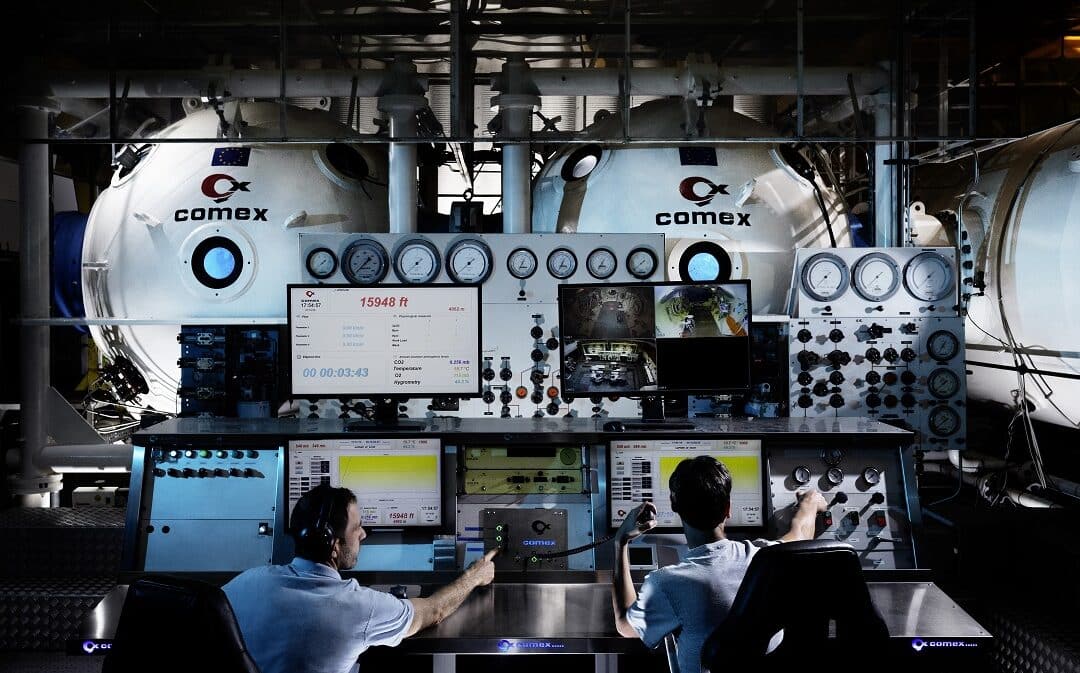
The tests conducted at COMEX consist of a six-hour denitrogenation phase during which participants breathe 100% oxygen, followed by physical exercise sessions performed in a hypobaric chamber simulating an altitude of 9,200 meters (approximately 30,200 feet), still under pure oxygen, corresponding to the operating pressure typically used in the Extravehicular Mobility Unit (EVA) suit, approximately 4.3 psi (0.3 atm).

Volunteers perform a range of effort scenarios representative of extravehicular activity constraints, including stair climbing at varying paces, arm ergometer exercises, object handling, and fine motor skills tasks. An ultrasound station is also used to detect in real time the possible formation of nitrogen bubbles within the body.

Numerous parameters are continuously monitored, including pressure (altitude), breathing gas composition and concentration levels, phase durations, temperature, and humidity, in order to collect essential biomedical data for protocol validation.

Close collaboration with NASA teams


The collaboration between COMEX and NASA was built on a foundation of transparency and scientific rigor. NASA teams visited the COMEX site on multiple occasions to prepare the test campaigns and ensure that the protocols applied were strictly identical to those used at the Johnson Space Center.

In parallel, COMEX teams were trained on-site at the Johnson Space Center in Houston in both equipment operations and test protocol implementation.

Data are shared with NASA in real time and subsequently analyzed jointly. At the end of each test campaign, a detailed report is delivered within short timeframes, contributing to the rapid advancement of ongoing research efforts.

International recognition and strategic perspectives


This first series of tests enabled NASA to officially validate COMEX as a test laboratory for xEVA simulation. COMEX is also the first of the selected centers to have successfully completed this campaign in its entirety, demonstrating its ability to meet the requirements of such a prestigious and demanding client.

Building on these results, NASA has already scheduled a second large-scale test campaign, with several dozen tests planned for 2026, aimed at identifying the most suitable denitrogenation protocol for astronauts involved in future exploration missions.

Profiles selection that meets spatial requirements


The conduct of these hypobaric trials relies on the participation of volunteers whose physiological characteristics are comparable to those of astronauts involved in NASA’s human spaceflight programs. The medical criteria applied are particularly stringent and include, in particular, excellent cardiovascular fitness, high aerobic capacity, the absence of cardiac or respiratory contraindications, and proven tolerance to confined environments.

These scientific requirements, which are essential to ensuring both the safety of the trials and the validity of the data collected, naturally limit the number of suitable profiles and represent one of the major challenges of this type of research involving human subjects. The trials are carried out within a rigorous ethical and regulatory framework, with continuous medical monitoring and real-time measurement of key physiological parameters such as pressure and respiratory gases.

COMEX continues its research activities in this field and remains available to respond to any institutional or scientific requests for information.

An exceptional scientific and human adventure


Beyond its scientific outcomes, this project is a great source of pride for COMEX teams. The mobilization of physicians, engineers, technicians, and project managers with a shared passion for space exploration made it possible to meet a complex challenge within tight timelines, in service of human space exploration.

Through this strategic partnership, COMEX once again confirms its ability to leverage its longstanding expertise in extreme environments to address the most ambitious challenges of international research.

Hypoxia Risk: Training now open to all professionals

Hypoxia Risk: Training now open to all professionals

Hypoxia Risk Prevention: Training now available to all aeronautical professionals and high-altitude specialists.

Hypoxia remains one of the most underestimated risks in altitude environments, whether in civil aviation, flight testing, or high-mountain activities. Insidious, progressive, and sometimes difficult to detect, it rapidly impairs cognitive and decision-making abilities, to the point of jeopardizing operational safety

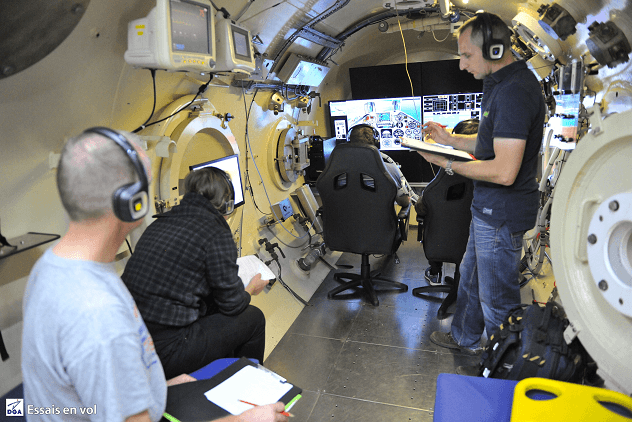
test de personnel dans le simulateur d'altitude

Drawing on its expertise in extreme environments, COMEX is now expanding access to its “Hypoxia Risk Awareness training course, initially developed in collaboration with EPNER, the French military test pilot school.
The training is now open to private pilots, airlines, commercial flight crews, instructors, as well as professionals exposed to altitude, particularly in the fields of mountaineering and high-altitude expeditions.

A major issue for aviation safety and high-altitude activities

In both the cockpit and high-altitude environments, the drop in partial oxygen pressure can trigger physiological effects that are often difficult to detect:

  • Impaired judgment
  • Reduced coordination
  • Slower reaction times
  • Decreased vision
  • A misleading sense of well-being

Each individual reacts differently to hypoxia, making it essential to recognize one’s own early symptoms, a critical factor for aviation safety and risk management.

The training offered by COMEX provides exactly this opportunity, enabling participants to identify their personal warning signs in a controlled and secure environment, supervised by medical specialists.

A realistic training approach combining theory and controlled exposure in a hypobaric chamber

The one-day course follows a comprehensive structure, alternating theoretical instruction with real-world simulations.


The instructional team is composed of COMEX staff for the technical components, and specialists from the Institute of Medicine and Physiology in Maritime and Extreme Environments (Phyrmarex) for the medical aspects.


1. Compréhension du phénomène hypoxique


Participants receive a structured lesson covering:


  • The effects of reduced oxygen levels
  • Physiological responses,
  • LOperational risks in aviation or high-altitude environments
  • Prevention procedures and safety guidelines.

  • 2. Practical session in a hypoxic chamber


    The practical module is the core of the training. Trainees are exposed to a simulated altitude of 9,300 ft (~2,850 m) with a hypoxic gas mixture containing 12% O₂, in an environment that reproduces in-flight conditions.


    Under the supervision of a specialized medical team:


    • Physiological parameters are continuously monitored (SpO₂, ECG, heart rate)
    • Individual symptoms are observed, identified, and analyzed
    • The session can be stopped at any time to ensure safety

    • This immersive experience enables participants to accurately recognize their own warning signs and develop the correct reflexes for real-life situations.

A training program now accessible to a wide range of professionals


COMEX and PHYMAREX are expanding access to this strategic training program to multiple categories of professionals.


Civil and private aviation


  • Private pilots (PPL, CPL, ATPL)
  • Airline pilots,
  • Instructors and examiners
  • Commercial flight crews (cabin crew),
  • Technical or maintenance teams required to work at altitude


Airlines and aviation organizations


  • Internal awareness training
  • Strengthening of aviation safety programs
  • Complement to CRM and Human Factors programs


High-altitude activities


  • Mountaineers and mountain guides
  • Scientific or sporting expeditions
  • Professionals exposed to altitude as part of their missions


The objective: to provide each participant with personal mastery of the risk, regardless of their operational context.

Strengthening safety through knowledge

Early recognition of hypoxia is an essential skill, both for aviation safety and for any activity exposed to altitude. Thanks to its expertise, unique facilities, and specialized supervision, COMEX and Phymarex offer immersive training that enables each participant to better protect themselves and act effectively to support collective safety.

To request a quote or schedule a dedicated session for your organization, our training team is at your disposal

Practical Information


  • Duration: 1 day (7 hours)
  • Location: COMEX Hypobaric Center – Marseille – France
  • roup size: up to 8 trainees (10 upon request)
  • Prerequisites: medical clearance for hypobaric exposure or a valid pilot/aircrew medical certificate
  • Pricing: quotation provided based on company requirements


Training contact:

Ms Anaïs Wackers – contact@comex.fr

A certificate of completion is issued at the end of the session.

COMEX and the Space Sector

COMEX and the Space Sector

COMEX and the Space Sector: A Historic Collaboration for the Future of Life Support in Extreme Environments

On November 8, 2024, the “Spaceships Meeting F2F” was held in Toulouse, organized by CNES. COMEX was represented by Dr. Adrien Gouyé.

For over 60 years, COMEX has been a key player in exploring and mastering extreme environments, thanks to its unique expertise in life support systems under hypo- and hyperbaric conditions. Today, this experience translates into a fruitful collaboration with the space sector. Partnering with agencies such as CNES, ESA, and NASA, COMEX is contributing to the development of life support technologies for habitats designed for upcoming missions, including lunar exploration in the coming years.

Unparalleled Expertise in Pressure Management

Rooted in decades of research and innovation, COMEX’s expertise in pressure management initially emerged in the context of saturation diving, with landmark projects like HYDRA 9 and HYDRA 10. COMEX divers reached record depths of up to 701 meters at the COMEX Hyperbaric Testing Center (CEH), demonstrating the reliability and safety of its confined environments. These technological advancements now form a cornerstone for research into survival systems in extreme environments, including tests on human endurance and simulations of intra- and extravehicular space activities.

Testing Environments for Future Exploration

Today, COMEX’s expertise is embodied in cutting-edge facilities such as the Hyperbaric Testing Center (CEH), a unique European simulator for confined environment testing. The CEH enables the reproduction of hypobaric conditions (a few hundred mBar) similar to those faced by astronauts in space. This capability allows COMEX to collaborate closely with the space sector to develop and validate survival protocols for challenging environments like the Moon and Mars, where life support challenges are significant.

Towards Air and Water Self-Sufficiency: COMEX Purification Projects

To support international space ambitions, COMEX has also developed advanced air and water purification systems. These essential technologies for space missions integrate coupled processes (plasma, photocatalysis, and fine particle filtration) to effectively remove chemical and biological pollutants in confined environments. For instance, the EPURA project focuses on sustainable water recycling, a priority for long-duration missions. Simultaneously, the MINERVE project aims to miniaturize purification equipment for use in space, adapting to specific constraints for intravehicular (IVA) activities.

2025: New Test Campaigns for the Space Sectorl

The collaboration between COMEX and the space sector continues to grow to meet the increasing demands of exploration missions. In 2025, specific test campaigns are planned at the CEH, particularly to validate oxygen pre-breathing protocols, essential for preventing decompression accidents during extravehicular (EVA) activities. These tests represent a crucial step before operational implementation, reaffirming COMEX’s role as a leading innovator in ensuring crew safety and well-being in space.

A Vision for Future Space Collaboration

With its historical experience and advanced technical capabilities, COMEX is ready to tackle the challenges of the future. The company continues to position itself as a strategic partner for space agencies by developing life support solutions tailored to the extreme conditions of space. COMEX’s vision for the future is clear: leveraging its expertise in pressure management and purification systems, the company is helping push the boundaries of human exploration beyond our planet.

We thank CNES for organizing this inaugural day of academic and industrial exchanges on Spaceship missions, robotic exploration, and human spaceflights.

Adrien Gouyé

PhD, COMEX

Development of the V-Care system for autonomous astronaut training

Development of the V-Care system for autonomous astronaut training

Development of the V-Care system for autonomous astronaut training.

The MEDES-COMEX consortium has developed on behalf of ESA a new tracking system for the crew’s physical exercises: Visual Controlled Bodytracking for Advanced Resistive Exercise (V-CARE).


Optimizing real-time body movement tracking

© Robert Markowitz

Context :


The International Space Station (ISS) plays a crucial role in facilitating in-depth research into the consequences of prolonged exposure to weightlessness on human health. These studies have identified significant issues such as bone deterioration, muscle atrophy, and the decline of cardiovascular function, among other detrimental effects. The need for resistive exercise as a countermeasure to these impacts of microgravity is now well established, thanks to decades of human experience in space. Indeed, scientific publications, such as those in the Journal of Bone and Mineral Research, have demonstrated the benefits of resistive exercise on bone health.


Therefore, performing physical exercises is essential to maintain optimal physical condition and limit these deconditioning effects. However, when carrying out these exercises, especially when they involve high loads, the risk of injuries, such as muscle pains, cannot be overlooked. A key study published in the Spine Journal in August 2017 notably highlighted the modifications of the spine and muscle atrophy suffered by astronauts, underscoring the importance of a preventative and adaptive approach in the development of physical training programs in space.

© ESA

Necessity of Innovation in the Space Context:


Currently, once or twice for a 6-month mission (often in the middle of the mission), a real-time teleconference (audio and video) is organized between the astronaut exercising on the ARED (Advanced Resistive Exercise Device) and the team of physical trainers located at a flight control center. The trainers can react in real time when inappropriate positions are observed. This procedure is not sufficient, and it is also restrictive because it requires a real-time connection and does not support the autonomy of the crew, which is an important element to consider. The implementation of a bodytracking system that displays in real time to astronauts when they are exercising at high intensity on ARED is perfectly justified and necessary from a safety perspective. To address this, the idea was to provide ESA with a markerless video capture system of movements allowing self-monitoring (by real-time video feedback) to the subject himself (the astronaut) during resistive exercise on the ISS’s ARED and also compatible with future exercise devices anticipated for upcoming exploration missions.


Presentation of the V-Care System:


To prevent injuries during countermeasure exercise sessions, the V-Care system, developed by COMEX, represents an advanced solution aimed at perfecting resistive exercises in space, particularly aboard the International Space Station (ISS). Utilizing Microsoft Azure Kinect technology, V-Care ensures 3D tracking of body movements without the need for markers. This feature not only facilitates its implementation and use but also allows real-time guidance of the astronaut through visual feedback during exercises.


Faced with technical challenges, including the impact of the participants’ clothing and environmental interferences on the quality of the capture, solutions have been developed to ensure the reliability of the data. For example, it is recommended that participants wear tight, light-colored clothing to minimize infrared signal disturbances and optimize motion capture. Moreover, the optimal positioning of participants relative to the Azure Kinect camera is crucial to maintaining the accuracy of the measurements. Its innovative architecture ensures seamless integration with equipment like the ARED, providing real-time feedback to astronauts to optimize the safety and efficiency of their training. This system represents a significant advancement in the physical preparation of space crews, offering a crucial tool for managing the risks associated with microgravity exercises, while overcoming technical challenges to maintain high quality of movement tracking.

© Robert Markowitz / Azure kinect / COMEX

Evaluation and Results:

The thorough evaluation of V-Care, focused on simulations of resistive exercises on a representation of ARED with 11 participants, employed a specific methodology to test the effectiveness and accuracy of the system under conditions mimicking the space environment. This evaluation phase included setting up several success criteria and performance measures, such as the accuracy of movement capture, the stability of the curves generated by the system, and the system’s ability to provide real-time feedback. Participants were invited to perform resistive exercises while wearing outfits optimized for motion capture, thus highlighting the importance of physical preparation and appropriate equipment. The analysis of the results revealed that 56 out of 66 tests were successful, demonstrating the effectiveness of the graphical user interface (GUI), currently based on oscillations, for precise and real-time tracking, and validating V-Care’s capability to provide accurate feedback for adapting and correcting posture and exercise execution.

Impact on Astronaut Training:


The impact of V-Care on astronaut training marks a significant evolution in physical preparation for space missions. By integrating an advanced real-time bodytracking system, V-Care enables better adaptation of resistive exercises, crucial for countering the adverse effects of microgravity on the human body. This technology not only enhances safety by reducing the risk of injuries through immediate posture corrections but also optimizes the efficiency of each training session, ensuring that astronauts maintain optimal physical condition throughout their mission.

© Azure Kinect / COMEX

Outlook:


The integration of V-Care into training routines on the ISS represents a significant advance in the physical preparation of space crews, offering a crucial tool for managing risks associated with exercises in microgravity. As part of the project’s continuation, a major update of the graphical user interface (GUI) is planned to include body tracking with a 3D representation of the astronaut, their avatar, currently based on oscillations. This development would allow for greater immersion and interaction, thereby facilitating more accurate and personalized feedback. Moreover, the V-Care system could be used on ESA’s “E4D” device for trials aboard the ISS in 2025, marking a step forward in space training technology.


Looking to the future, V-Care could be adapted for missions to Mars, offering a compact and efficient solution for maintaining the musculoskeletal health of astronauts during extended space missions. Studies on the effectiveness of feedback in physical training support the idea that accurate and real-time feedback can significantly improve the quality of exercises by helping to maintain correct body alignment, prevent injuries, and optimize muscle recovery, which is crucial for long space missions where access to full medical facilities is limited. V-Care’s ability to adapt to various training needs and provide detailed performance analyses could transform the way astronauts train, enhancing their health and overall performance in space.

Partner: MEDES has unique expertise in space medicine and in the evaluation/research involving human subjects as well as in the operational implementation of European life sciences experiments conducted aboard the ISS (MARES & SARCOLAB 1 & 2 experiments).

© CNES – MEDES
Simulate extreme depressurization conditions with our depressurized chambers

Simulate extreme depressurization conditions with our depressurized chambers

La Comex installe un simulateur de vols dans son caisson hypobare

In the aviation industry, the safety of passengers and crew is of utmost importance. In-flight depressurization scenarios can be particularly critical, requiring rigorous testing and validation to ensure the reliability of systems and equipment on board aircraft. That’s where our company, a leader in pressure and depressurization testing for over 60 years, comes into play. With our comprehensive range of state-of-the-art hypobaric chambers, we are capable of simulating vacuum and depressurization with exceptional precision.

Depressurized Chamber: An Essential Tool for the Aerospace Industry

Our altitude simulator is designed to replicate real-life depressurization conditions encountered during flight. By utilizing cutting-edge technology, we can safely simulate extremely low-pressure environments and emergency situations. This enables aerospace companies to test their systems, equipment, and procedures under conditions similar to those experienced in actual flight.

Features and Benefits of Our Hypobaric Chambers:

Precision and Reliability: Our hypobaric chambers are meticulously designed to accurately reproduce depressurization profiles specific to different types of aircraft. This ensures reliable and reproducible results, enabling aerospace companies to make informed decisions regarding design and safety.

    • Flexibility: Our comprehensive range of hypobaric chambers can be tailored to the specific needs of each aerospace company. Whether you need to test avionics systems, structural components, or survival equipment, our chambers can be configured to meet your particular requirements.


    • Safety:Safety is our top priority. Our depressurized chambers are equipped with advanced safety systems to ensure the protection of your teams and equipment during testing. We ensure that all necessary safety measures are in place to minimize potential risks.


  • Technical Expertise: With over 60 years of experience in pressure and depressurization testing, we have a team of highly skilled technical experts. Their expertise allows us to provide comprehensive technical support, from the initial design of tests to the analysis of results.

Moon surface simulator

Moon surface simulator

Moon surface simulator

Prepare human and robotic exploration on the moon

The decade in which we live will see the return of man to the Moon accompanied by robotic systems.

The COMEX hydrosphere is a unique installation in Europe. A vacuum chamber of five meters in diameter containing 3.5 tons of regolith simulant, which is used to carry out preparation tests for future missions on the lunar soil.
The facility, referenced by ESA (European Space Agency), allows the development of specific test capabilities to simulate spacewalks.

One of the main constraints of operations on the lunar ground is the dust found there, the regolith. The abrasive nature of regolith causes damage, mechanical failure, material wear, etc.
Currently, there are few facilities in the world where the effects of lunar dust can be tested in a vacuum environment. COMEX has the only facility in Europe where such tests can be performed.

Currently, there are few facilities in the world where the effects of lunar dust can be tested in a vacuum environment. COMEX has the only facility in Europe where such tests can be performed.

Simulate surface operations with a lunar ground (simulating) in the vacuum

In the world, there are several chambers or ground models that can be used for equipment testing, either in vacuum conditions recreating a lunar atmosphere, or on a ground simulating the lunar soil. But very few means simulate both at the same time.

The HYDROSPHERE lunar surface simulator proposed by COMEX is therefore an additional asset for the development of space activities at the European level. The possibility of simulating lunar surface operations under vacuum in a chamber 5 meters in diameter offers a very wide field of exploration.

The installation is composed of three vacuum tightly sealed chambers and a control center.

The 5 m diameter sphere is the main element of the facility, allowing to reproduce the lunar surface with its 3.5 tons of regolith (simulant).

In terms of geochemistry, various regolith simulants can be available ranging from high-fidelity, for example for sampling, sample analysis, and ISRU testing, to low-fidelity simulants and rocks that can be used to test the mobility and situational awareness of a rover. COMEX is currently in possession of EAC-1 simulant provided by ESA-EAC filling the HYDROSPHERE ground. 

Adjacent to the sphere, for all intra-vehicular activities (life in confinement, telemedicine), is a second enclosure used as an airlock and a third enclosure, the habitat, a chamber that provides space for a crew of up to eight subjects. The habitat has a volume that is close to the COLUMBUS laboratory of the ISS. .

The main sphere can be serviced by a crane and can receive large elements of 2m diameter from its top.

Human mission simulations

Surface simulations, manned flights, habitats and life support systems

The Hydrosphere installation can be used for various simulations

  • Future human and robotic missions on the lunar surface or Mars.
  • Understanding of the human factors of spaceflight
  • Simulations of habitat operations and life support systems

The similarity of the hydrosphere habitat volume to the internal volume of the ISS COLUMBUS has been instrumental in the ESA BIOMODEXO project, where mathematical models of bio-contamination have been validated inside the habitat and could also be used to develop methods against dust introduction for future expeditions to the Moon or Mars.

The adjacent control center is used to monitor activity inside the facility. It also allows to:

    • To simulate a mission control, as a center in communication with the crew with the addition of a delay in the links
    • Evaluate the human-robot interactions that are simulated, for example between the habitat and the main sphere or directly between an astronaut and the robot both in the sphere containing the regolith.

In addition to the lunar environment, the simulator can also be used for other planetary applications such as the technological demonstration of the Mars sample recovery rover, drones (flight systems in a low density atmosphere) or any other similar application identified in the context of extraterrestrial exploration missions.

Another advantage is that the configuration of the sphere allows the testing of EVA suits and equipment, textiles and materials, and their resistance to the environment: wear and tear and mechanical failure tests.

Robotic mission simulations

Future missions to the Moon will most likely see the advent of cooperation between astronauts and explorers or robotic helpers. The strength of the COMEX Hydrosphere installation is that it simply offers the possibility to simulate different mission scenarios with such robots

  • The robot in the sphere and a crew controlling it from the supervision center
  • Man and robot in the sphere, in cooperation
  • A drone flight in a controlled atmosphere

The expertise in controlled pressure acquired by COMEX for more than 60 years and the infrastructures present on its site make it a unique test and trial center in Europe, whether for underwater, terrestrial or extraterrestrial applications. This is why COMEX has been involved in the development of space projects since the 1980s in collaboration with ESA and CNES and why its facilities are listed with these agencies.

COMEX supports ESA astronaut training

COMEX supports ESA astronaut training

COMEX supports ESA astronaut training

As ESA recently selected a new class of astronauts, we take the opportunity to present our activity as a service provider supporting ESA for a specific Astronaut Training activity. Since 2019, COMEX is working with ESA to implement underwater training and test activities in the Neutral Buoyancy Facility (NBF) at the European Astronaut Center (EAC) in Cologne (Germany).

selection des astronautes europeens 2022
Class of 2022 – Credits : ESA

ESA’s latest Astronaut recruitment campaign ended on November 23, 2022. Out of 22,523 applicants, ESA selected 17 new Astronaut Candidates to whom we send our sincere congratulations. Among those, two French Astronauts were selected, Sophie Adenot as a career astronaut and Arnaud Prost, a former COMEX project engineer and diver, as a reserve Astronaut. Starting next year, five career astronauts of this new ESA Astronaut Class will receive the ESA Basic Training organized at the European Astronaut Centre (EAC) in Cologne, Germany. This is the first training phase for all Astronaut Candidates after their selection, introducing them to different fundamental knowledge and skills for spaceflight. The COMEX diving Team in Cologne will support ESA to implement the spacewalk skill training part of this Basic Training in the Neutral Buoyancy Facility (NBF) at EAC.

The Neutral Buoyancy Facility (NBF) at the European Astronaut Center

centre d'entrainement europeen NBF

NBF with diving tank: 10m deep, 22m length and 17m width (credits: COMEX)

The NBF is a unique European Training Facility housing a 10m deep diving tank, training mock-ups, that represent parts of the International Space Station (ISS), and a Control Room from which Underwater Activities can be monitored and guided.

The contract concerning the NBF support between ESA and COMEX was first signed in spring 2019. Since then, COMEX has supported ESA for all NBF activities with a team of local safety divers supervised by our project Manager, Kathrin Nowak. Under the coordination of Hervé Stevenin, the ESA Astronaut Trainer for Extravehicular Activities (EVA), the Diving Team provides technical support and ensures the safety during the implementation of Underwater training and test activities.

EVA : The main Training Activities at NBF

The NBF core activity is the EVA Pre-Familiarization and Proficiency Training for ESA Astronauts for Extra-Vehicular Activities (EVA a.k.a. “spacewalks”). The European astronauts are trained by ESA on the rules of engagement of EVAs, through underwater simulations of typical ISS spacewalk tasks performed inside the NBF in neutral buoyancy simulating weightlessness.

These activities prepare them for training in spacesuits at NASA in Houston. ESA’s newly recruited career Astronauts will go through the NBF EVA Pre-familiarization Training as part of their Basic Training starting in April 2023. This Training will be provided by the ESA Trainer Hervé Stevenin, who received several NASA EVA Trainings in Houston himself.

Hervé Stevenin en formation EVA

Herve Stevenin in EVA Training by NASA at the Neutral Buoyancy Laboratory (NBL) in Houston (Credits: NASA/ESA)
.

entrainement astronautes en NBF ESA
ESA Astronaut in NBF EVA configuration during Training (credits: H. Rueb)

To prepare the Astronaut Candidates for their first EVA training sessions underwater, they will have to go through several training sessions to prepare them to dive in the unique NBF EVA configuration. As ESA has not developed a European space suit, astronauts in the NBF train in a custom-made gear allowing them to speak with the Astronaut Trainer in the Control Room (via a communication line and a Full Face Mask) and to carry and operate the NASA EVA standard Tools with EVA gloves like they will later do it during their EVA suited runs at NASA.

After several breaks in the NBF ctivities due to refurbishment activities in the last couple of years the NBF diving Team is now busy in preparing the upcoming Basic Training in 2023. This includes the testing of all relevant training hardware and equipment, implementing proficiency training of the team, performing rescue drills and completing the rehearsal of all diving training lessons the Astronauts will receive.

NBF Divers  (crédits : B. Schulze)

Kathrin NOWAK, our project manager in charge of diving operations

Kathrin is a COMEX project manager in Cologne, Germany. She has been working in the Neutral Buoyancy Facility (NBF) for over 12 years. After gaining experience as a freelance diver she joined the safety diver team of the European Astronaut Center in 2009. In 2010 she supported the Basic Training of the ESA Astronaut Class 2009 in the NBF and several following Astronaut Training and ESA test. campaigns. Since 2018 she works for COMEX and manages the diving team supporting ESA in the preparation and implementation of all diving operations in the NBF.

Beyond this project, Comex has also been a partner of ESA and CNES for many years on various topics for the space sector. Our team works, among other things, on R&D projects such as the VCARE device, or projects around future space habitats and life support system such as air/water filtration equipment in space. These projects, carried out at the Marseille site, are based on COMEX infrastructures, unique in Europe, providing for example the possibility of simulating lunar surface operations under vacuum.

V-Care project

V-Care project

Since man has been exploring space, one of the greatest challenges has been to be able to stay there for a long period of time (6 months). It is known that with time, the absence of gravity causes a premature aging of the bones as well as a muscular atrophy in the astronaut. It is therefore essential to regularly practice optimized resistive physical exercises to counteract muscle and bone loss during space flights.


VCARE (ESA contract 4000127147/19/NL/KML)

Objectives

  • Detection of an individual’s joint centers to estimate joint angle oscillations during physical exercises
  • Optimization of muscular fatigue with an adapted program to strengthen the muscles
  • Improvement of space travel conditions and optimization of the payload at the start of the space trip

One of the objectives of the researchers is to control the posture of the astronaut during resistive exercise sessions to optimize the efficiency while reducing the risk of injury following misuse, in particular for body movements requiring high loads as it is the case with the ARED device (for “Advanced Resistive Exercise Device”) on board the International Space Station ISS. To do this, one solution is to use a tool that allows real-time tracking of movements in order to correct them in real time, as all sports coaches do.

Within the framework of a technological demonstrator, ESA asks for an evaluation of the performances of a system developed by COMEX with the support in space medicine brought by the MEDES.

Context

COMEX has developed a motion analysis system called V-Care allowing the tracking of 3D motion, the advantage of which is that it is markerless body-tracking. The system uses two cameras that are compact and easy to install.

The purpose of the study presented here was to evaluate the accuracy of this system from selected joint angles. The data obtained with V-Care was compared to a Gold Standard system in the field.

The two systems were compared during three resistive physical exercises representative of a functional evaluation at the Technosport of Aix-Marseille University.

Results

This study aimed to compare the performance of a markerless motion capture system, V-Care, to the gold standard in the field.

The V-Care system performs better in tracking the two main joints of the lower limbs. For the upper limbs, the error is more important.

In spite of this lower precision on the upper limbs, the V-Care system seems to be adapted for the real follow-up of physical exercises in the framework of space flights. Its “Plug & Play” aspect allows an easy and fast use compared to the preparation time of the standard Gold system in the field. The latter can be of the order of a day for the initial installation of a dozen cameras, plus half an hour for the installation of the markers.

Perspectives

To conclude this study, the V-Care appears to be a simple to use and sufficiently accurate tool for tracking movement during functional tasks.

The next step is to integrate the V-Care system in a resistive exercise device simulating the ARED.

Altitude simulator

Altitude simulator

As expert in hyperbaric simulation and operations, COMEX created its altitude simulator in 2016. This test facility recreates pressure conditions at altitude. This altitude chamber is now a reference tool for the aeronautics and space industry, to meet their needs for validation and certification of new equipment.

Meeting the needs of the aerospace industry

The altitude simulator, developed and transformed over the past 10 years by COMEX within its hypobaric test center, meets the growing need for testing methods to simulate altitude conditions for human subjects. This 20m² hypoxic chamber cabin can accommodate several people (subjects, medical staff, technical staff) at the same time and simulate flights up to 40,000 feet (~12,000m) in altitude. These aeronautical altitude tests are always conducted under medical supervision.

Medical support

To this end, COMEX has joined forces with Phymarex: a group of doctors, nurses and researchers who are experts in underwater, aeronautical and space medicine. These specialists have been using hyperbaric and hypobaric chambers to treat various pathologies since the 1970s. During the 2000’s, they started a collaboration with occupational physicians in the aeronautical sector, in order to assist them in the realization of studies on the flight personnel. Gradually these studies were carried out in the COMEX  altitude simulator. Further, in 2016, the Regional Health Agency (ARS) granted COMEX approval to carry out tests, under medical supervision on healthy subjects. This approval has led to a wide variety of tests being carried out. Research and development on medical equipment, onboard equipment such as oxygen masks and smoke protection hoods. But also physiological experiments for adaptation to very high altitude environments

Hypoxic training

Or finally, as explained by Dr Mathieu Coulange (Head of the hyperbaric center of the APHM) for the sensibilization to the hypoxic risks for flight personnel.

« Or finally, as explained by Dr Mathieu Coulange (Head of the hyperbaric center of the APHM) for the sensibilization to the hypoxic risks for flight personnel. “We install them on a flight simulator and we reproduce the cabin environment. After having them breathe air at the beginning of the session, without warning them, we will switch them to a 12% under-oxygenated mixture, they will feel symptoms due to hypoxia, which they will have to announce, to be able to prepare them to detect the lack of oxygen which could happen when there is a cabin depressurization or when the oxygen masks malfunction.»

To date, more than 150 people have participated in these simulated flights, without a single medical accident.

Throughout its history, COMEX has demonstrated its ability to push back the limits of professional diving thanks to two axes: innovations in equipment and a better understanding of the physiological effects of high pressure.
It is now continuing this work by focusing on altitude and very high altitude.

Hypoxia risk awareness

Hypoxia risk awareness

The Comex Hypobaric Test Center is pleased to regularly receive a delegation of students and instructors of EPNER (School of flight test and reception staff) for an hypoxia risk awareness session in altitude chamber hypoxia training.

©EPNER

EPNER

Formerly flight test center / CEV created in 1946, now part of DGA Flight Test Dpt, EPNER trains crews involved in test flights ; theoretical courses come along practical hands-on exercises that allow in-flight tests of the aircraft characteristics, carried out under the optimum safety conditions. Trainees are : test pilots, engineers, mechanical and test engineers as well as air traffic controllers for specific test flights.

Located in Istres (60 km from Marseilles) since 1962, EPNER carries out its activities within the DGA (General Delegation for Weapons, a branch of French MOD). This gives the school a unique position between the Armed forces and the Industry on one hand, and between military and civilian testing sectors on the other hand. EPNER has been training crews in these different areas for more than 70 years.

The high quality of this training, based on teamwork between pilots, engineers and air traffic controllers, is recognized at the highest levels of the international aviation community.

 Comex Altitude Simulator for human subject test aeronautical oxygen equipment 

 In order to carry out hypobaric tests in the field of aeronautics and space, Comex Test Center of has been equipped since 2017 with an hypoxic chamber, also called hypobaric chamber oraltitude simulator.

The possibility of reproducing in this 20m2 hypoxic room flight conditions up to 40 000 meters of altitude (131 000 feet), allows our partners, the main european and worldwide international organizations and industries in the aeronautics and aerospace sectors, to perform, with the help of our dedicated staff, tests on human behaviour, as in this case a simulation of hypoxia – and also qualification tests for equipment and materials.

Total control of extreme conditions of pressure and temperature allows our company to be involved in a very wide range of projects.

Hypoxia situation in COMEX altitude chamber

 With the unit set up in the flight simulator mode, this test was designed to allow EPNER trainees to face hypoxia situations in the most realistic possible conditions.

This allowed the crew to be exposed to hypoxia in an attempt for each trainee to identify possible precursory physiological signs.

It further allowed detection of equipment failures (O2 breathing masks) or structural damage on the aircraft (due to sudden pressure loss etc.).
It also emphasized the dangers of flying at high altitude.

Under these various situations, trainees had to apply recently learned techniques to bring the crew safely back to the ground or to a possible ejection zone.

 Medical supervision

Medical assistance was provided all through the test sessions by the Institute of Physiology and Medicine in the Maritime Environment and Extreme Environment “PHYMAREX” which brings together a group of doctors and nurses mainly from the Public Assistance of Marseille Hospitals (APHM) and more precisely the Hyperbaric Center of Sainte Marguerite University Hospital. Operational members are trained in hyperbaric medicine and / or emergency medicine and / or aeronautical and aerospace medicine.

Under the supervision of Dr. Mathieu COULANGE, emergency physician specializing in hyperbaric medicine, maritime medicine and aeronautical medicine. Head of the hyperbaric, underwater and maritime medicine department of Sainte Marguerite University Hospital.

EUROPEAN SPACE AGENCY ASSIGNS COMEX TO SUPPORT THE UNDERWATER TRAINING OF ASTRONAUTS IN COLOGNE

EUROPEAN SPACE AGENCY ASSIGNS COMEX TO SUPPORT THE UNDERWATER TRAINING OF ASTRONAUTS IN COLOGNE

PRESS RELEASE

COMEX and the European Space Agency (ESA) have signed a contract on astronaut underwater training at the European Astronaut Centre (EAC) in Cologne.

On May 18th, 2019, the Marseille-based enterprise COMEX (Compagnie Maritime d’Expertises) and the European Space Agency (ESA) have signed a contract on supporting the underwater training of astronauts and operations of ESA’s Neutral Buoyancy Facility (NBF) at the European Astronaut Centre in Cologne. The NBF is a unique training and testing facility housing a 10 m deep water tank, in which full scale mock-ups of International Space Station (ISS) modules are immerged. This is the only place in Europe, where astronauts receive training for Extra-Vehicular Activities (EVA) also known as spacewalks. ESA has developed and implemented in the NBF a world-wide unique EVA Prefamiliarisation Training Programme to train the European astronauts on the rules of engagement for spacewalks on the International Space Station (ISS). This programme has proven its efficiency with the multiple spacewalk assignments of ESA astronauts in the past 10 years and is also used as EVA proficiency training in Europe. “This innovative ESA training has been in place for already 15 years and is regularly enhanced through a very fruitful cooperation with NASA. Its objective is to boost ESA astronaut initial EVA capabilities in safely and efficiently performing EVA tasks, before they get exposed to the spacesuit constraints through their further EVA skill training by NASA in Houston. Having now COMEX on board is an additional and appreciated asset for the diving activities in the NBF” says Hervé Stevenin, ESA Head of the EVA training at EAC.

The NBF also offers the capability to simulate the Moon gravity through immersions in slightly negative buoyancy. ESA has already prototyped Lunar EVA equipment & tools, which have been tested in simulated lunar gravity inside the NBF tank for the preparation of the ESA upcoming contribution to the return of humans to the Moon surface.

The present contract also includes the continuation of these activities to test European lunar surface operations and hardware to prepare the return of astronauts on the Moon. “Within this contract we will provide ESA with a team of divers to support the training of astronauts underwater for missions to the International Space Station (ISS). But the project goes beyond ISS and will also serve to support ESA contribution to future human lunar exploration missions” says Alexandre Oskian, Director at COMEX. The company is working for ESA on several projects related to the future Moon exploration and is actively investigating spin-off technologies and synergies between the maritime and space sectors.

Kathrin Nowak, NBF Diver and COMEX Team Lead at the European Astronaut Centre says: “Most of the divers working for COMEX in Cologne have a long experience of supporting astronaut training and tests at the Neutral Buoyancy Facility. We are happy that we can combine the expertise of COMEX and the proficiency of the diving team to support ESA in NBF activities”.

About COMEX
The Compagnie Maritime d’Expertises (COMEX) was founded in 1961 by Henri Germain Delauze (1929-2012). It is a worldwide pioneer in offshore diving and technologies for human interventions in extreme environments. The Compagnie is involved in several projects for the European Space Agency on the development of technologies to return humans to the Moon such as the development of materials of future space suits (Project PEXTEX) or the design of the Science Airlock for the future space station GATEWAY (Project ESPRIT under a contract with AIRBUS).

PEXTEX Project

PEXTEX Project

New intelligent materials for future space suits

All space agencies are preparing for a return of humans to the Moon in the near future!

In this context, the European Space Agency (ESA) has launched the PEXTEX project, which stands for “Planetary EXploration TEXtiles”. The project’s objective is to identify new materials and textiles capable of withstanding the hostile environments of the Moon and Mars for use in future space suits.


Why this project?

50 years after the Apollo missions, human space exploration is on the cusp of a new era, with the European Space Agency (ESA) and its international partners working towards the return of humans to the Moon. The goal of future missions is to establish a permanent presence on the lunar surface. In this context, the European Space Agency (ESA) launched the “PEXTEX” project, which stands for “Planetary EXploration TEXtiles”.

Project Objective:

The objective of the project was to identify new materials and textiles capable of withstanding the hostile environments of the Moon and Mars for the future European space suit. Signed on January 17, 2019, the study, which will span several years, was entrusted to COMEX SAS as coordinator and its European partners, the Germans from DITF and the Austrians from OeWF.

The project aims to identify new innovative and extremely robust materials, in addition to the materials already existing in space suits. This is to protect against dangers, but also to analyze the environment, monitor the health of astronauts, etc. The possibilities are numerous. For example, on the lunar surface, there are micrometeorite showers; the search for textiles capable of maintaining their structural integrity is a major challenge, given the disastrous consequences that a tear in a space suit could cause!

To achieve this, and to be better adapted to this environment, the study will identify materials capable of resisting the many external aggressions:

The regolith, one of our worst enemies on the Moon, is as fine as talcum powder and composed of tiny silica particles, sharpened like razor blades.
Solar and cosmic radiation, our worst enemies, as it is very complicated to protect oneself from them with a space suit.
The vacuum of space
Extreme temperatures: the surface of the space suit in the sun reaches 150°C, while if it passes into the shade it drops to -170°C.
Micrometeorites, which arrive at 10 km/s and can pass through a thin aluminum plate.


The materials identified in the PEXTEX project were tested in test facilities with partner organizations in France, Germany, and Austria. A dedicated platform was designed by the COMEX team and used at the Marseille site for specific testing under ultravacuum conditions.

The closing conference was conducted by COMEX in late March 2023, at the technical headquarters of the ESA (ESTEC) in the Netherlands. About twenty European experts were present, and two ESA astronauts even had the pleasure of participating. In fact, these European astronauts are potential candidates to wear a space suit and explore the Moon.

The identification and testing of such materials will serve to develop future European space suits for extravehicular activities (EVA) on the lunar (and Martian) surface. These space suits will need to be designed to withstand longer and more frequent surface operations than during the Apollo period.

Project closure

This project is part of ESA’s exploration strategy to return to the Moon in the coming decades, just like the development of GATEWAY, the future lunar orbit space station. This station will serve as a “base camp” for conducting robotic and human missions on the lunar surface. COMEX also participated in this project for ESA in partnership with Airbus, as part of the development of one of the modules of this space station, the European module “ESPRIT.”

In conclusion, materials were identified, manufactured, and then tested in facilities in France, Germany, and Austria. A special COMEX machine was designed for testing under ultravacuum conditions. European astronauts also participated in the project’s closing conference. The identified materials will be used for the development of future European space suits for extravehicular activities on the lunar and Martian surfaces. The PEXTEX project is part of ESA’s exploration strategy to develop future lunar bases on the Moon and the future international space station in cislunar orbit, GATEWAY.


Special COMEX machine dedicated to ultravacuum testing &

Final Meeting – European Space Research and Technology Centre (ESTEC)